
H-1B tax mistakes cost immigrants thousands of dollars every year not because the rules are impossible to follow, but because nobody explained them clearly when they arrived. Alex Rivera’s colleague Diego filed the wrong tax form for two years before realizing he had been underreporting his worldwide income. The IRS sent him a CP2000 notice with $8,400 in back taxes, a 20% accuracy penalty, and months of stress during his H-1B renewal.
This guide covers every mistake that triggers IRS audits, penalties, and visa renewal problems for H-1B holders with the exact penalty amounts, the IRS notices you will receive, and the step-by-step fix for each one.
Already filed incorrectly? Read this first: How to File Taxes as an H-1B Visa Holder in 2026 Have foreign bank accounts? Read this: What Is FBAR? A Guide for Immigrants Not sure if you need an ITIN or SSN? Read this: ITIN vs SSN in 2026
Why H-1B Tax Mistakes Are More Dangerous Than You Think
Most tax mistakes are just financial you pay back taxes plus interest and move on. For H-1B holders, the stakes are higher. USCIS checks your tax transcripts during H-1B extensions, green card applications, and naturalization. An unresolved IRS issue unfiled returns, back taxes, IRS liens can flag your immigration file and delay or jeopardize your application.
This is not speculation. USCIS Form I-485 (Adjustment of Status) asks whether you have ever failed to file a required federal, state, or local tax return. IRS problems and immigration problems are connected in ways most H-1B holders do not realize until it is too late.
Mistake 1: Filing the Wrong Tax Form
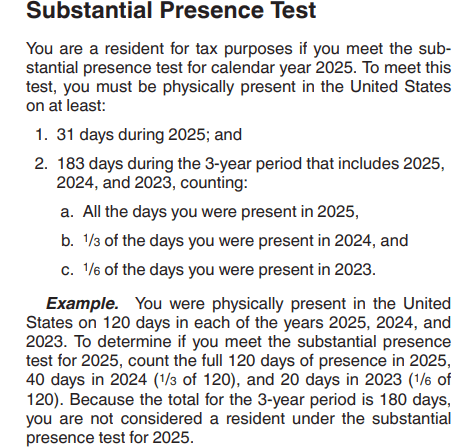
What happens: Many H-1B holders file Form 1040-NR (the nonresident alien return) when they should be filing Form 1040 (the resident alien return). This happens because they arrive thinking of themselves as foreign nationals which they are for immigration purposes but for tax purposes, they became resident aliens the moment they passed the Substantial Presence Test.
The Substantial Presence Test calculated example:
| Year | Days Present | Multiplier | Counted Days |
|---|---|---|---|
| 2025 | 245 | 1 | 245 |
| 2024 | 180 | 1/3 | 60 |
| 2023 | 90 | 1/6 | 15 |
| Total | 320 → Resident Alien |
320 days exceeds 183. This person is a resident alien for 2025 and must file Form 1040 not 1040-NR.
What goes wrong: Form 1040-NR only reports U.S.-source income. Form 1040 requires worldwide income. If you filed 1040-NR when you should have filed 1040, you underreported income. The IRS matches your W-2 data, visa status records, and days of presence. When it finds the mismatch, it sends a notice.
The consequences:
| Penalty | Rate | Cap |
|---|---|---|
| Failure to file correct form | 5% of unpaid tax per month | 25% of unpaid tax |
| Accuracy penalty (understatement) | 20% of underpayment | No cap |
| Accuracy penalty (negligence) | 20% of underpayment | No cap |
| Civil fraud | 75% of underpayment | No cap |
| Minimum late penalty (60+ days) | $525 or 100% of unpaid tax | Whichever is smaller |
| Daily interest | Federal rate + 3% | Ongoing until paid |
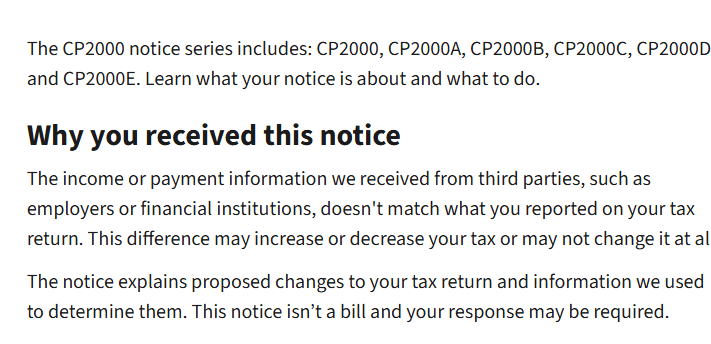
IRS notice triggered: CP2000 “We changed your tax return.” This notice proposes additional tax based on income the IRS found that you did not report.
Visa renewal risk: USCIS checks tax transcripts. A CP2000 with unpaid back taxes that appears during your H-1B extension review creates delays. An IRS tax lien filed when taxes remain unpaid appears in public records and can be flagged during background checks.
The fix:
- Recalculate your residency status using Publication 519 Chapter 1
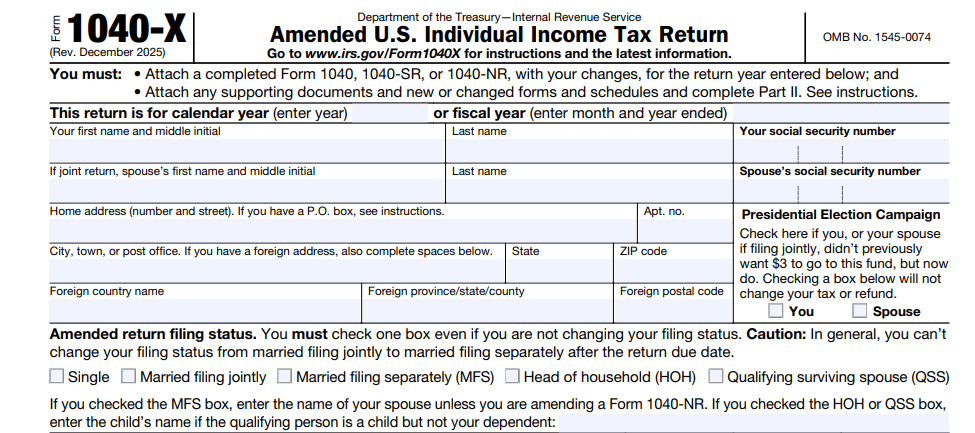
- If you should have filed Form 1040 file Form 1040-X (Amended Return) for each affected year
- Report worldwide income on the amended return
- Claim the foreign tax credit on Form 1116 for taxes already paid abroad on that income
- Pay any balance due immediately to stop the penalty clock
Mistake 2: Filing Late or Not Filing at All
What happens: H-1B holders must file a U.S. tax return regardless of whether they owe taxes or are getting a refund. Many assume that if their employer withheld enough tax, they do not need to file. This is wrong. The filing requirement and the payment requirement are separate obligations.
The deadlines:
| Situation | Deadline |
|---|---|
| H-1B holder with U.S. wages | April 15, 2026 |
| Extension filed (Form 4868) | October 15, 2026 |
| Payment of taxes owed | April 15, 2026 even with extension |
Critical rule: Form 4868 extends your time to file not your time to pay. If you owe taxes and file an extension but do not pay by April 15, penalties and interest accrue from April 15 on the unpaid balance.
The consequences:
| Penalty | Rate |
|---|---|
| Failure to file | 5% of unpaid tax per month, up to 25% |
| Fraudulent failure to file | 15% per month, up to 75% |
| Failure to pay | 0.5% of unpaid tax per month, up to 25% |
| If IRS sends levy notice | Failure-to-pay rate increases to 1% per month |
| Minimum penalty (60+ days late) | $525 or 100% of unpaid tax whichever is smaller |
| Daily interest | Federal rate + 3% from April 15 |
Real example: An H-1B holder with $5,000 in unpaid taxes files 6 months late with no extension. Failure-to-file penalty: 5% × 6 months = 30%, but capped at 25% = $1,250. Failure-to-pay penalty: 0.5% × 6 months = 3% = $150. Interest: approximately $75. Total extra cost: $1,475 on a $5,000 bill.
IRS notice triggered: CP501 “You have a balance due.” If ignored, CP503, then CP504 (Notice of Intent to Levy), then actual levy of wages or bank accounts.
Visa renewal risk: Unfiled tax returns are a direct red flag during H-1B extensions and green card applications. USCIS requests tax transcripts. A missing transcript for a year you were present and working is unexplainable.
The fix:
- File immediately even if you cannot pay. Filing stops the failure-to-file penalty.
- File Form 4868 before April 15 if you need more time
- If years are already missed file all missing returns immediately. The IRS Voluntary Disclosure program and reasonable cause arguments can reduce penalties for non-willful late filers
- Set up a payment plan at IRS.gov/paymentplan if you cannot pay in full
Mistake 3: Not Reporting Worldwide Income
What happens: Once you are a resident alien, you report income from every country not just the U.S. Many H-1B holders from India, Philippines, Nepal, and other countries have savings accounts, fixed deposits, rental income, or investment income back home. They report their U.S. W-2 correctly but completely omit the foreign income.
What counts as worldwide income:
- Interest from NRE, NRO, or savings accounts in your home country
- Dividends from foreign stocks or mutual funds
- Rental income from property you own abroad
- Salary from any work done for a foreign employer
- Capital gains from selling foreign property or investments
- Income from a family business abroad
The consequences:
| Type of understatement | Penalty |
|---|---|
| Negligence or disregard of rules | 20% of underpayment |
| Substantial understatement | 20% of underpayment |
| Fraud | 75% of underpayment |
| Undisclosed foreign asset transaction (FATCA-related) | 40% of underpayment |
IRS notice triggered: CP2000 when the IRS receives information from foreign financial institutions through FATCA reporting. Yes, banks in India, Philippines, and most countries now report U.S. account holders’ information to the IRS through FATCA agreements.
The fix:
- Go back through all years since you became a resident alien
- Identify all foreign income bank statements, brokerage statements, rental records
- File Form 1040-X for each year with unreported income
- Claim Form 1116 foreign tax credit for taxes already paid on that income abroad
- This typically reduces or eliminates double taxation
Mistake 4: Missing FBAR and FATCA Reporting
What happens: This is the most expensive mistake H-1B holders make. It is not about paying more tax FBAR and FATCA are reporting requirements, not tax obligations. But the penalties for missing them are severe and completely disproportionate to the account balance.
FBAR FinCEN Form 114
You must file FBAR if the combined balance of all your foreign financial accounts exceeded $10,000 at any single point during 2025. Not the year-end balance. Any day during the year.
| Detail | Rule |
|---|---|
| Threshold | $10,000 combined, any single day |
| Accounts covered | Bank accounts, savings, brokerage, mutual funds, some pensions |
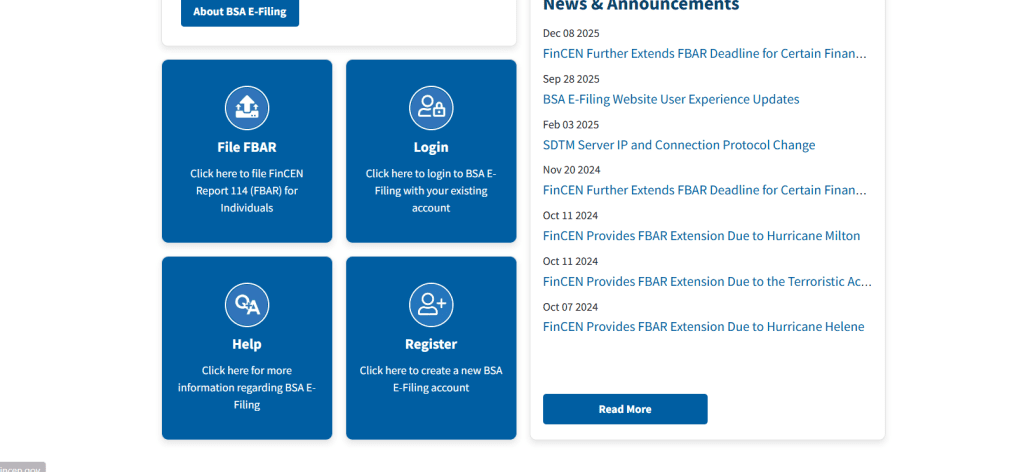
| Where to file | bsaefiling.fincen.treas.gov free, electronic only |
| Deadline | April 15, 2026 auto-extends to October 15 |
| Non-willful penalty | Up to $16,536 per missed annual filing (2026 inflation-adjusted) |
| Willful penalty | Up to $161,170 per account per year OR 50% of account balance |
| Criminal penalty (willful) | Up to 5 years imprisonment |
Important Bittner ruling (2023): The Supreme Court confirmed non-willful FBAR penalties are assessed per annual filing not per account. If you missed one year with two foreign accounts, your non-willful exposure is up to $16,536 not $33,072.
FATCA Form 8938
Form 8938 is filed with your tax return. Different thresholds than FBAR:
| Filing status | Year-end threshold | Any-point threshold |
|---|---|---|
| Single or MFS, living in U.S. | $50,000 | $75,000 |
| Married filing jointly, living in U.S. | $100,000 | $150,000 |
| Violation | Penalty |
|---|---|
| Failure to file Form 8938 | $10,000 initial penalty |
| Continued failure after IRS notice | Up to $50,000 additional |
| Underpayment tied to undisclosed foreign asset | 40% accuracy penalty |
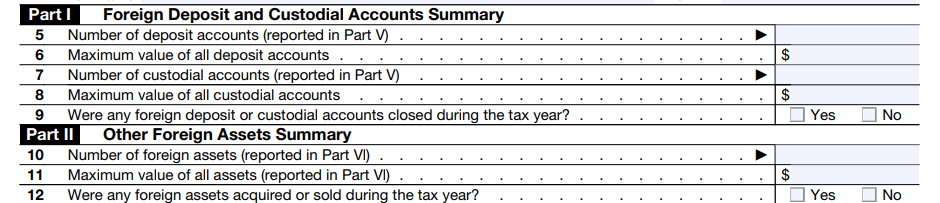
Both can apply to the same person in the same year. Filing FBAR does not satisfy Form 8938. They are separate obligations filed with separate agencies.
Real example: An H-1B holder from India has an NRO account that peaked at $22,000 in March when family deposited money. Year-end balance: $8,000. They miss FBAR because they check December 31 balance. The IRS discovers the account through FATCA reporting. Non-willful FBAR penalty: up to $16,536. On a $22,000 account.
IRS notice triggered: CP2000 or examination notice when FATCA data reveals unreported foreign accounts. FBAR violations are referred to FinCEN and can result in separate civil or criminal proceedings.
The fix:
- File late FBARs immediately at bsaefiling.fincen.treas.gov select “late filing” and explain your reason
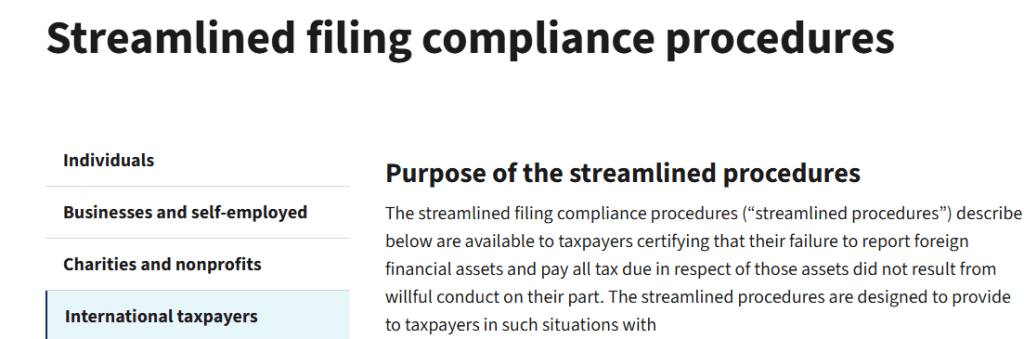
- If multiple years are missed consider the IRS Streamlined Filing Compliance Procedures, which provides penalty relief for non-willful violations
- For Form 8938 file amended returns (Form 1040-X) with Form 8938 attached
- Consult a CPA or tax attorney before using Streamlined Procedures the election is irreversible
Mistake 5: Incorrect FICA Withholding After Status Change
What happens: When an H-1B holder’s tax status changes from nonresident to resident which happens mid-year in the first year FICA obligations change simultaneously. Some employers fail to update withholding. Some H-1B holders who were previously on student visas (exempt from FICA) carry the exemption assumption into their H-1B employment incorrectly.
H-1B holders are NOT exempt from FICA. From your first day of H-1B employment:
- Social Security: 6.2% on wages up to $184,500 (2026)
- Medicare: 1.45% on all wages
When withholding mismatch occurs:
| Scenario | Problem | IRS Action |
|---|---|---|
| Employer under-withheld FICA | You owe unpaid FICA at tax time | CP2000 or balance due notice |
| Employer over-withheld at nonresident rate | Incorrect 30% withholding on wages | Refund claim via Form 1040 |
| W-2 and 1042-S both issued | Duplicate income reporting | IRS matching error, audit risk |
The consequences: Underpayment penalty of 0.5% per month on unpaid taxes up to 25%, plus daily interest at federal rate + 3%.
The fix:
- Review your W-2 boxes 4 and 6 these show Social Security and Medicare taxes withheld
- If FICA was not withheld when it should have been you and your employer each owe half
- Employer corrects their share via Form 941-X
- You claim credit for your share on Form 1040 and may owe the balance
- Submit Form W-4 to your employer with updated withholding instructions whenever your status changes
- If you have a totalization agreement get a certificate of coverage from your home country’s social security agency before claiming any FICA exemption

Mistake 6: Mishandling the Dual-Status Year
What happens: In the year you arrive in the U.S. on an H-1B, you are likely a dual-status alien nonresident for part of the year, resident for the rest. This is the most complex return you will ever file. Most people get it wrong.
The dual-status filing restrictions:
| Item | Dual-Status Rule |
|---|---|
| Standard deduction | Cannot claim must itemize |
| Filing status | Cannot file jointly (unless Section 6013(g) election) |
| Earned Income Credit | Cannot claim |
| Education credits | Cannot claim |
| E-filing | Cannot e-file must paper file |
| Credit for Elderly/Disabled | Cannot claim |
The most expensive dual-status mistake: Claiming the standard deduction ($15,750 for 2026) on a dual-status return. The IRS will reject this and recalculate your tax without it. If you have no itemized deductions to offset, your taxable income increases by $15,750 costing you $1,932 to $3,542 in additional tax depending on your bracket.

The Section 6013(g) election: If you are married and your spouse is a nonresident alien, you can elect to file jointly by treating your spouse as a resident for the entire year. This allows the standard deduction and joint filing rates but requires reporting your spouse’s worldwide income too. This election is made by attaching a signed statement to your return. It cannot be revoked without IRS permission.
The fix:
- Identify your exact residency starting date your first day of physical presence in the U.S.
- File Form 1040 as your main return if you were a resident on December 31
- Attach Form 1040-NR as a statement (marked “Dual-Status Statement”) showing nonresident period income
- Do not claim the standard deduction
- Use tax software that supports dual-status returns or hire a CPA this is the one situation where professional help pays for itself
Mistake 7: Missing Treaty Benefits or Claiming Wrong Ones
What happens: H-1B holders from treaty countries either miss benefits they are entitled to or claim benefits that no longer apply because of the saving clause.
The saving clause problem: Most U.S. tax treaties contain a saving clause. Once you are a U.S. resident alien, the U.S. reserves the right to tax you as if the treaty did not exist. This means the treaty benefits you enjoyed as a nonresident reduced withholding rates on dividends, scholarship exemptions often disappear the moment you become a resident.
Treaties with important exceptions to the saving clause:
- India: Article 21 saving clause exception for students and business apprentices
- Philippines: pension income exceptions
- South Korea: certain income exceptions for students
How to correctly claim a treaty benefit:
Step 1: Confirm your treaty is still active. Russia, Belarus, and Hungary treaties are suspended or terminated as of 2026.
Step 2: Identify the specific article that applies. Use IRS Publication 901 at https://www.irs.gov/pub/irs-pdf/p901.pdf
Step 3: Confirm the saving clause does not eliminate the benefit for residents.
Step 4: Report treaty-exempt income on Form 1040 Line 1k.
Step 5: Complete Schedule OI Item L with treaty country, article number, and exempt amount.
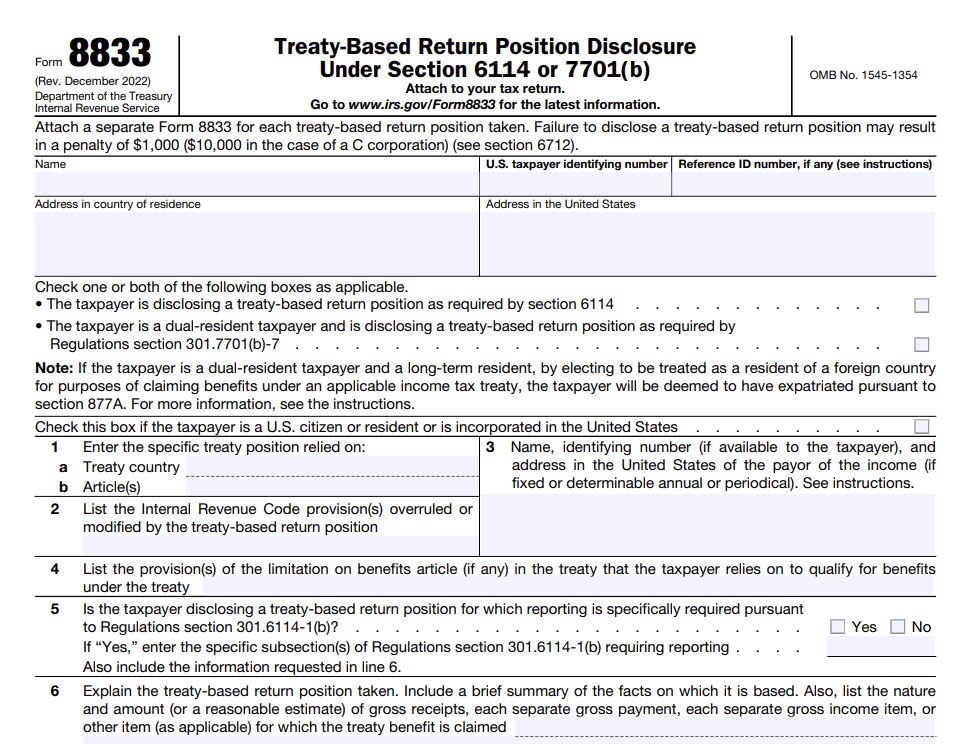
Step 6: Attach Form 8833 if your treaty position reduces tax by more than $10,000 or overrides an IRC rule.
Penalty for incorrect treaty claim: 20% accuracy penalty on any underpayment resulting from an incorrect treaty position, plus a $1,000 penalty for failing to file Form 8833 when required.
Mistake 8: Not Updating W-4 After Salary Changes or Status Changes
What happens: Your W-4 tells your employer how much tax to withhold from each paycheck. If you never updated it after a salary increase, a promotion, a spouse’s income change, or your tax status change from nonresident to resident, your withholding is probably wrong.
Common W-4 problems for H-1B holders:
| Situation | Result |
|---|---|
| Salary increased, W-4 not updated | Under-withholding, surprise tax bill in April |
| Became resident alien, W-4 not updated | Possibly over or under-withheld |
| Spouse started working, W-4 not updated | Household income underestimated, under-withheld |
| RSUs vested, no supplemental withholding | Large unexpected tax bill |
RSU (Restricted Stock Unit) trap: When RSUs vest, their value is ordinary income reportable in the year of vesting. Many employers withhold at a flat 22% supplemental rate. If your effective tax rate is higher common for H-1B holders earning $120,000+ you owe the difference.
The fix:
- Go to IRS.gov/W4App the IRS withholding estimator
- Enter your actual income including all sources salary, RSUs, spouse income, foreign income
- Update your W-4 at work based on the result
- Do this every January and after any major income change
Penalty Summary Table
| Mistake | IRS Notice | Penalty Range | Visa Risk |
|---|---|---|---|
| Wrong tax form | CP2000 | 20-75% accuracy penalty + interest | High |
| Late filing | CP501/CP503 | 5% per month up to 25% + interest | High |
| Missing worldwide income | CP2000 | 20-40% accuracy penalty | Medium |
| Missing FBAR | FinCEN referral | Up to $16,536 per year non-willful | Medium |
| Missing FATCA Form 8938 | Examination | $10,000-$50,000 | Medium |
| Wrong FICA withholding | Balance due notice | 0.5% per month + interest | Low |
| Dual-status standard deduction | Recalculation notice | Back taxes + interest | Low |
| Wrong treaty claim | CP2000 | 20% accuracy + $1,000 Form 8833 | Low |
When to Hire a CPA Non-Negotiable Situations
Do not attempt to handle these yourself:
- Multiple years of missed FBAR filings Streamlined Procedures require careful handling
- IRS audit notice or examination letter
- Tax liability over $10,000
- Dual-status year with complex foreign income
- IRS lien or levy notice
- Green card application with unresolved tax issues
- Foreign business ownership or partnership interests
A CPA who specializes in international tax typically charges $500 to $1,500 for an H-1B return. That is cheap compared to a $16,536 FBAR penalty or a delayed green card.
Pre-Filing Checklist H-1B Mistake Prevention
- ✅ Calculated residency status using Publication 519 substantial presence test
- ✅ Confirmed correct form Form 1040 for residents, Form 1040-NR for nonresidents
- ✅ Identified ALL worldwide income U.S. and foreign
- ✅ Checked all foreign account peak balances during 2025 FBAR required if any day exceeded $10,000 combined
- ✅ Checked Form 8938 thresholds $75,000 any-point for single filers living in U.S.
- ✅ Verified FICA withholding on W-2 boxes 4 and 6
- ✅ Checked totalization agreement if home country is on SSA list
- ✅ Confirmed treaty benefits still apply post-saving clause if claiming any
- ✅ Updated W-4 with employer for current year
- ✅ If dual-status year confirmed not claiming standard deduction
- ✅ Filed FBAR at bsaefiling.fincen.treas.gov if required
- ✅ Deadline confirmed April 15 for most H-1B holders with U.S. wages
Frequently Asked Questions
Can H-1B tax mistakes affect my green card application?
Yes. USCIS requests tax transcripts during I-485 (Adjustment of Status) processing. Missing returns, unpaid taxes, and IRS liens all appear and can cause delays or requests for evidence. File all required returns and resolve any IRS issues before filing I-485.
What is a CP2000 notice?
A CP2000 is an IRS notice proposing changes to your return based on income the IRS received from third parties (employers, banks, foreign institutions) that does not match what you reported. It is not an audit it is a proposed adjustment. You can agree, disagree with explanation, or request more time.
I filed 1040-NR but should have filed 1040. How far back do I need to amend? Generally the IRS has 3 years to assess additional tax from the original due date of the return. However, if you underreported income by more than 25%, the IRS has 6 years. For unfiled returns, there is no statute of limitations the IRS can assess tax at any time. File all missing or incorrect returns as soon as possible.
Can FBAR penalties be reduced?
Yes. Non-willful FBAR penalties can be reduced or waived for reasonable cause. The IRS Streamlined Filing Compliance Procedures offer significant penalty relief for non-willful violations. Penalties are often waived entirely for first-time filers who come forward voluntarily before IRS contact.
Will the IRS find my foreign bank account?
Increasingly yes. Over 100 countries participate in FATCA information exchange agreements with the U.S. Foreign banks report U.S. account holders’ information annually to their local tax authority, which shares it with the IRS. Indian banks, Philippine banks, and most European banks now report U.S. persons’ accounts.
My employer never withheld FICA. Am I responsible?
Both you and your employer are responsible for unpaid FICA. Your employer owes their half plus a trust fund penalty for failing to withhold. You owe your half. If your employer refuses to correct the issue, you can file Form 843 to claim a refund or credit on your return for FICA you effectively paid twice, or report the employer to the IRS.
Conclusion
H-1B tax mistakes are not inevitable. Every mistake in this guide has a clear trigger, a predictable consequence, and a straightforward fix. The H-1B holders who get into serious trouble are not the ones who make the mistakes — they are the ones who ignore the notices, miss the deadlines, and assume the IRS will not find foreign accounts.
The IRS will find them. The USCIS will check your transcripts. Fix the mistakes early while penalties are manageable and before immigration applications are affected.
Read next:
- How to File Taxes as an H-1B Visa Holder in 2026 the complete filing guide
- What Is FBAR? A Guide for Immigrants full FBAR filing walkthrough
- How to File Form 1040-NR as a Nonresident Alien if you are still a nonresident
Sources
- IRS Publication 519, U.S. Tax Guide for Aliens (2025): https://www.irs.gov/pub/irs-pdf/p519.pdf
- IRS Publication 17, Your Federal Income Tax (2025): https://www.irs.gov/pub/irs-pdf/p17.pdf
- IRS CP2000 Notice Information: https://www.irs.gov/individuals/understanding-your-cp2000-notice
- IRS Failure to File Penalty: https://www.irs.gov/payments/failure-to-file-penalty
- IRS Accuracy-Related Penalties: https://www.irs.gov/taxtopics/tc306
- FinCEN FBAR: https://www.fincen.gov/report-foreign-bank-and-financial-accounts
- IRS FATCA Form 8938: https://www.irs.gov/businesses/corporations/foreign-account-tax-compliance-act-fatca
- IRS Streamlined Filing Compliance Procedures: https://www.irs.gov/individuals/international-taxpayers/streamlined-filing-compliance-procedures
- IRS FICA for H-1B Holders: https://www.irs.gov/individuals/international-taxpayers/aliens-employed-in-the-us-social-security-taxes
- IRS Tax Treaties A-Z: https://www.irs.gov/businesses/international-businesses/united-states-income-tax-treaties-a-to-z
- IRS Withholding Estimator: https://www.irs.gov/individuals/tax-withholding-estimator
- IRS FBAR Guidance (including Bittner ruling impact):
https://www.irs.gov/businesses/small-businesses-self-employed/report-of-foreign-bank-and-financial-accounts-fbar
Disclaimer This article is for informational purposes only and does not constitute tax or legal advice. Tax rules are complex and fact-specific. Consult a licensed CPA or tax attorney for advice specific to your situation.