
How to file taxes as an F-1 student visa holder was the question Diego faced in his first March in the United States. He had arrived from Spain on an F-1 visa to pursue his PhD, received a university stipend, worked part-time on campus, and now had a stack of forms he did not recognize. Was he a resident? Did he file the same form as his American classmates? Did he owe FICA taxes? What about his scholarship?
Most F-1 students get this wrong because they use tax software designed for U.S. citizens and residents. This guide covers the exact rules for F-1 holders for the 2025 tax year filed in 2026.
Not sure whether you need an ITIN or SSN? Read this: ITIN vs SSN in 2026 Already on H-1B after F-1? Read this: How to File Taxes as an H-1B Visa Holder in 2026 Filing as a nonresident alien? Read this: How to File Form 1040-NR
Step 1: Determine Your Residency Status as an F-1 Student
The first question is the same as for every visa holder: are you a resident alien or nonresident alien for U.S. tax purposes? Your F-1 immigration status does not automatically answer this tax residency is determined separately.
The Exempt Individual Rule The 5 Year Clock
F-1 students have a special rule that most other visa holders do not: you are an exempt individual for purposes of the Substantial Presence Test for your first five calendar years of physical presence in the U.S. on F-1 status.
What exempt individual means: Your days of presence in the U.S. during those five years do NOT count toward the 183-day Substantial Presence Test. This means most F-1 students remain nonresident aliens for their entire first five years regardless of how many days they spend in the U.S.
Important: Exempt individual does not mean exempt from taxes. It only means you do not count days toward the residency test.
The 5-year rule in detail:
- The 5-year limit counts calendar years not consecutive years and not 60-month periods
- Any part of a calendar year counts as one full year
- The 5-year limit applies to your time in student status. If you later return to the U.S. in a different non-student status for example as a J-1 researcher or professor a separate 2-year exempt individual clock applies to that status. The 5-year student clock does not reset, but it also does not eliminate exemptions available under different visa categories.
- If you were previously on J-1 status as a student, those years count toward your 5-year total
After 5 calendar years: Your days of presence begin counting toward the Substantial Presence Test. If you meet the test (31 days in 2025 plus 183 weighted days over three years), you become a resident alien for tax purposes even if you still hold an F-1 visa. As a resident alien you file Form 1040 and report worldwide income.
Can you stay nonresident after 5 years? Yes but only if you can demonstrate to the IRS that you do not intend to reside permanently in the U.S. and that you have continued to comply with your visa requirements. This requires documenting ties to your home country.
Diego’s situation: He arrived in August 2024. That counts as one calendar year (2024). In 2025 he was present all year that is year two. He is still an exempt individual and a nonresident alien for 2025.
Step 2: Understand Which Forms You Must File
F-1 students must file different forms depending on their income situation. Many students miss this entirely.
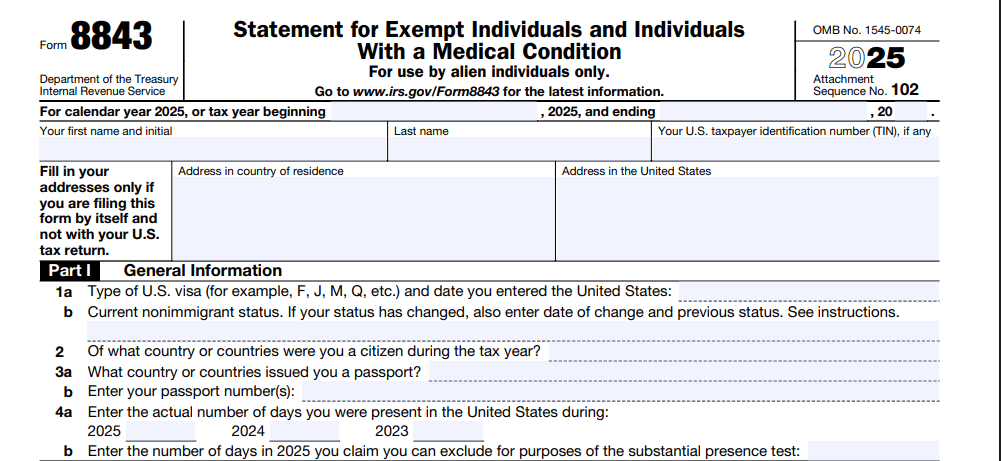
Form 8843 Required for Every F-1 Student
Form 8843 is not a tax return. It is an information statement that tells the IRS you are claiming exempt individual status under the Substantial Presence Test. Every F-1 student who was present in the U.S. during 2025 must file it even if you had zero income.
| Your situation | What to file |
|---|---|
| F-1 student in U.S. less than 5 years, no U.S. income | Form 8843 only |
| F-1 student in U.S. less than 5 years, with income | Form 1040-NR + Form 8843 |
| F-1 student in U.S. more than 5 years, meets SPT | Form 1040 + Form 8843 |
Where to file Form 8843 if you have no income: Mail it separately to: Department of the Treasury Internal Revenue Service Center Austin, TX 73301-0215
Deadline for Form 8843 only (no income): June 15, 2026 this is a widely used convention among universities and tax preparers, not a separately published IRS deadline. The IRS technically ties Form 8843 to your 1040-NR due date. If you later discover you had reportable income, your 1040-NR was due April 15 and you may face a late filing issue. When in doubt, file by April 15 Deadline for Form 1040-NR with income: April 15, 2026
What happens if you do not file Form 8843: If you fail to file Form 8843, the IRS may determine that your days of presence count toward the Substantial Presence Test. If you then meet the test, you become a resident alien subject to tax on worldwide income, loss of FICA exemption, and required to file Form 1040. This is one of the most expensive administrative mistakes an F-1 student can make.
Form 1040-NR Required if You Have U.S. Income
If you earned wages, received taxable scholarship income, or had any other U.S.-source income during 2025, you must file Form 1040-NR.
Do NOT use TurboTax, H&R Block, or any standard consumer tax software. These products are designed for U.S. residents and default to Form 1040. Using them as a nonresident F-1 student will produce an incorrect return. Use software specifically designed for nonresident aliens such as Sprintax or Glacier Tax Prep.
Step 3: Know Your FICA Exemption
This is the most valuable tax benefit F-1 students have and the most commonly violated by employers.
F-1 students are exempt from FICA (Social Security and Medicare taxes) for their first five calendar years in the U.S.
This exemption is under IRC Section 3121(b)(19). It applies to:
- On-campus employment
- Curricular Practical Training (CPT)
- Optional Practical Training (OPT) both pre-completion and post-completion
- Employment authorized due to severe economic hardship
The FICA rates you should NOT be paying during your first 5 years:
- Social Security: 6.2% of wages
- Medicare: 1.45% of wages
- Total: 7.65% of every paycheck
On a $30,000 annual stipend, that is $2,295 per year you should never lose to FICA. Many employers withhold it anyway especially for OPT students.
After 5 calendar years: If you become a resident alien by meeting the Substantial Presence Test, you become liable for FICA on all wages same as any U.S. employee. The standard FICA rates apply.
One exception worth noting: even after becoming a resident alien, F-1 students doing on-campus work at their own university while enrolled at least half-time may still qualify for a separate FICA exemption under IRC Section 3121(b)(10). This applies only to work at your own school it does not apply to OPT or CPT employment with outside employers. For most students on OPT, this exception is irrelevant. For students working as on-campus TAs or RAs after their 5-year mark, ask your university’s payroll department whether this exception applies.
If your employer withheld FICA in error:
Step 1: Request a refund directly from your employer. They can correct it through Form 941-X.
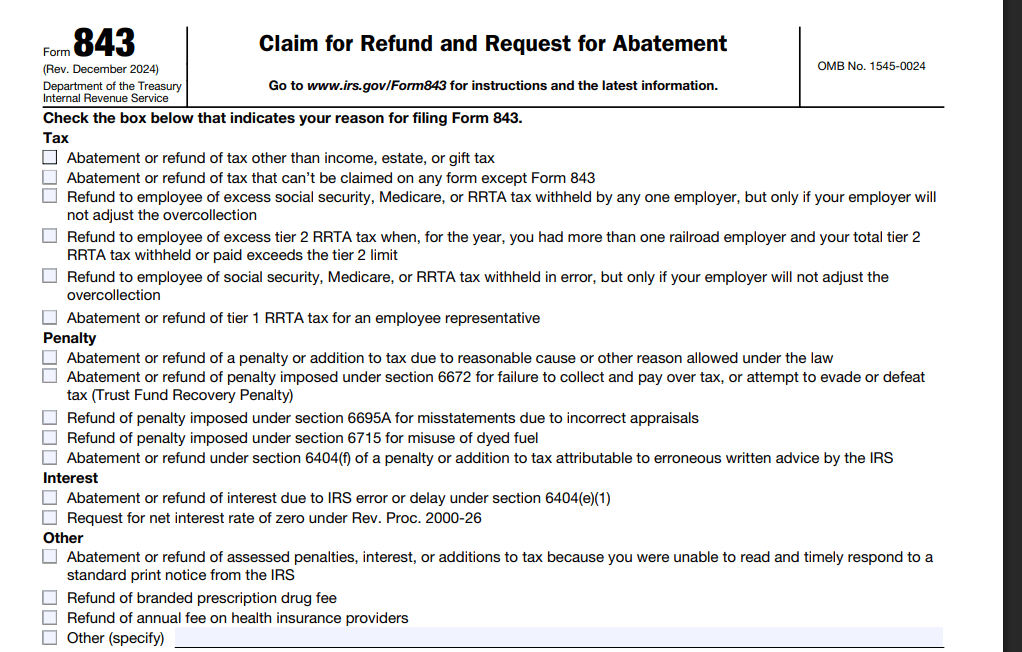
Step 2: If your employer cannot or will not refund it file Form 843 (Claim for Refund) with Form 8316 attached. Include your W-2, proof of F-1 status (copy of visa and I-94), and a statement explaining why FICA should not have been withheld.
Step 3: Mail to the IRS service center shown in the Form 843 instructions. Claims must generally be filed within 3 years of the original return due date.
Step 4: Understand OPT and CPT Income Tax Rules
OPT and CPT income is taxable. The FICA exemption does not mean your wages are tax-free it only means Social Security and Medicare are not withheld.
What you owe on OPT/CPT wages as a nonresident alien:
- Federal income tax at graduated rates (same as ECI for nonresidents)
- State income tax depending on your state
- No FICA (first 5 years)
Your employer should give you a W-2 showing wages in box 1. Report these wages on Form 1040-NR page 1 as effectively connected income.
OPT STEM extension: The 24-month STEM OPT extension does not change your tax treatment. You remain subject to the same rules as standard OPT for tax purposes.
Important withholding issue: Some employers withhold federal income tax at the 30% nonresident alien flat rate on OPT wages. This is incorrect wages for services performed in the U.S. are Effectively Connected Income (ECI) taxed at graduated rates, not at 30%. If your employer withheld at 30% on OPT wages, you will receive a refund when you file Form 1040-NR correctly.
Step 5: Understand Scholarship and Fellowship Taxability
This is where most graduate students get confused. Not all scholarship money is taxed the same way.
Tax-Free Scholarship Income
If you are a degree seeking student, the following scholarship amounts are not taxable and do not need to be reported:
- Tuition and required enrollment fees
- Required books, supplies, and equipment for your courses
Taxable Scholarship Income
The following scholarship amounts are taxable and must be reported on Form 1040-NR:
- Room and board
- Travel expenses
- Any stipend paid in exchange for teaching, research, or other services (this is wages, not scholarship)
- Scholarship amounts exceeding qualified education expenses
The service requirement distinction: If your university pays you a stipend specifically for being a teaching assistant or research assistant, that income is wages not scholarship. It is reported on a W-2 or 1042-S and taxed as ECI at graduated rates. A pure scholarship with no service requirement uses different withholding rules.
Withholding rates on scholarships:
- Standard rate for nonresident alien students: 14% (not 30%)
- The 14% rate applies to F-1/J-1/M-1/Q-1 students on scholarships not covered by a treaty
- If 30% was withheld on your scholarship, you likely have a refund coming
Your university should issue Form 1042-S for scholarship income. Report this on Form 1040-NR Schedule NEC if it is non-ECI passive income, or on page 1 if it is wages for services.
Step 6: Claim Treaty Benefits If Available
The U.S. has tax treaties with dozens of countries that provide specific benefits for students. Many F-1 students from treaty countries miss these benefits entirely.
Common student treaty benefits:
- India Article 21: Exempts scholarship, fellowship, and certain stipend income for students and business apprentices
- China Article 20: Exempts scholarship and fellowship income; limited wage exemption for students
- South Korea Article 21: Student exemption provisions
- Many European countries various student income exemptions
How to claim a treaty benefit:
Step 1: Identify your country’s treaty at https://www.irs.gov/pub/irs-pdf/p901.pdf (IRS Publication 901)
Step 2: Find the specific article that covers student income in your country’s treaty
Step 3: Report the treaty-exempt income on Form 1040-NR Line 1k
Step 4: Complete Schedule OI Item L with your treaty country, article number, and exempt amount
Step 5: Attach Form 8833 if your treaty position reduces your tax by more than $10,000 or overrides an IRC rule. For most student scholarship exemptions, Form 8833 is not required but include a disclosure statement with your return explaining the treaty claim.
The saving clause warning: Most U.S. tax treaties contain a saving clause that eliminates treaty benefits once you become a U.S. resident alien. If you pass the 5-year mark and become a resident alien, most student treaty benefits no longer apply.
Step 7: FBAR Obligations for F-1 Students
Most F-1 students in their first 5 years do NOT have FBAR obligations.
Here is why: FBAR applies to U.S. persons which includes resident aliens. As a nonresident alien during your first 5 calendar years, you are generally not classified as a U.S. person for FBAR purposes.
However, FBAR does apply to you if:
- You have passed the 5-year mark and become a resident alien
- Your foreign bank account balances combined exceeded $10,000 at any point during 2025
If you are a resident alien F-1 student and your home country savings account even one your parents contribute to peaked above $10,000 at any day in 2025, you must file FBAR.
Read the full FBAR guide: What Is FBAR? A Guide for Immigrants with Foreign Bank Accounts
State Tax Rules for F-1 Students
Federal and state tax rules do not always match. This is one of the most overlooked areas for F-1 students.
Key issues to know:
Most states follow federal residency rules if you are a nonresident alien federally, you are typically a nonresident for state purposes too and file a state nonresident return if required.
However, some states do not recognize federal tax treaties: California is the most important example if you claim a federal treaty exemption that reduces your income, California will still tax that income at the state level. A student who is federally exempt on $5,000 of scholarship income under a treaty may still owe California state tax on that $5,000.
States with no income tax: Texas, Florida, Washington, Nevada, Wyoming, South Dakota, Alaska. If you live and study in one of these states, you have no state income tax obligation.
What to do: Check your specific state’s department of revenue website for nonresident alien and international student guidance. Your university’s international student office often publishes state-specific tax guidance for their location.
Diego’s Filing Situation What He Actually Did
Diego arrived in August 2024 (year 1). He worked as a teaching assistant throughout 2025 (year 2). He received a university stipend of $22,000 half for teaching services, half as a scholarship for tuition.
His income breakdown:
- Teaching assistant wages (W-2): $11,000 taxable ECI
- Scholarship for tuition: $11,000 not taxable (qualified education expense)
Forms he filed:
- Form 1040-NR reported $11,000 in TA wages as ECI
- Form 8843 attached to confirm exempt individual status
- No FICA withheld his university’s payroll department correctly applied the Section 3121(b)(19) exemption
Treaty benefit: Spain has a limited tax treaty with the U.S. Diego checked IRS Publication 901 and found that the U.S-Spain treaty Article 22 provides an exemption of up to $5,000 for wages earned for maintenance or study purposes. He claimed this exemption on Form 1040-NR Line 1k and reported only $6,000 as taxable TA income. He attached Schedule OI Item L with the treaty details. This saved him approximately $900 in federal tax.
His refund: His university had withheld federal income tax at 14% on the scholarship stipend portion before realizing it was a tuition payment. Diego received a full refund of that withholding.
Pre-Filing Checklist for F-1 Students
- Counted calendar years in F-1 status confirmed still within first 5 years or determined residency status if past 5 years
- Form 8843 prepared required even with zero income
- If income received: Form 1040-NR prepared (not Form 1040)
- Identified all income sources TA wages, OPT/CPT wages, scholarship stipends
- Confirmed FICA was not withheld if withheld, Form 843 prepared for refund
- Scholarship income categorized qualified (tuition) vs. taxable (room/board, services)
- Treaty benefits checked using Publication 901
- Form 8843 deadline confirmed June 15, 2026 if no income; April 15, 2026 if income
- Nonresident tax software used not TurboTax or H&R Block standard versions
- If past 5 years and resident alien FBAR obligations checked for foreign accounts over $10,000
- F-2 dependents: If any family members are present in the U.S. on F-2 visas, each one must file their own separate Form 8843 even with zero income. One Form 8843 per person.
Frequently Asked Questions
Does my spouse or child on an F-2 visa need to file anything?
Yes. Every person present in the U.S. on an F-2 visa during 2025 must file their own Form 8843. F-2 holders cannot file a joint Form 8843 with the F-1 student. Each person files individually. Mail all forms together in the same envelope if filing without income.
Do I have to file taxes if I had no income as an F-1 student?
You do not file a full tax return, but you must still file Form 8843 if you were present in the U.S. during 2025. File it by June 15, 2026 and mail it to the Austin IRS center.
Can I use TurboTax as an F-1 student?
No. TurboTax and most consumer tax software produce Form 1040 the resident alien return. As a nonresident F-1 student you need Form 1040-NR. Use Sprintax, Glacier Tax Prep, or a tax professional experienced with nonresident aliens.
My employer withheld FICA from my OPT wages. What do I do?
First ask your employer to correct it through Form 941-X. If they cannot, file Form 843 with Form 8316 attached. Include your W-2, visa documentation, and a written explanation. File within 3 years of the original return due date.
Is my OPT income taxable?
Yes. OPT wages are taxable as U.S.-source income reported on Form 1040-NR. The FICA exemption means Social Security and Medicare are not withheld it does not make the income tax-free.
What is Form 1042-S?
Form 1042-S is issued by universities and employers to report U.S.-source income paid to nonresident aliens including scholarship stipends, fellowship payments, and wages subject to treaty benefits. You may receive both a W-2 and a 1042-S in the same year depending on your income types.
I am in my 6th year on F-1. Am I now a resident alien?
Not automatically. You need to calculate whether you meet the Substantial Presence Test using the 3-year weighted formula. If you meet the test, yes you are a resident alien, file Form 1040, report worldwide income, and are subject to FICA. If you do not meet the test and can show no intent to remain permanently, you may remain a nonresident.
Does my country have a tax treaty with the U.S.?
Check IRS Publication 901 at https://www.irs.gov/pub/irs-pdf/p901.pdf for the complete list of U.S. tax treaties and the specific articles that apply to students.
What happens if I file Form 1040 instead of Form 1040-NR by mistake?
File an amended return using Form 1040-X and attach Form 1040-NR as the corrected return. Filing the wrong form can cause you to lose treaty benefits, overpay or underpay tax, and create IRS correspondence issues. Correct it as soon as you discover the mistake.
How to File Taxes as an F-1 Student Visa Holder in 2026?
Filing taxes as an F-1 student visa holder requires following a different process than U.S. citizens or residents. Most F-1 students in their first five calendar years remain nonresident aliens for tax purposes and must file Form 1040-NR (if they have income) along with Form 8843. Use nonresident tax software such as Sprintax or Glacier Tax Prep instead of TurboTax. Always file Form 8843 to protect your exempt individual status under the Substantial Presence Test.Key steps include determining your residency status, reporting wages and taxable scholarships correctly, claiming any available tax treaty benefits, and ensuring FICA taxes were not improperly withheld.
Conclusion
Filing taxes as an F-1 student comes down to three things: file Form 8843 every year without exception, use Form 1040-NR not Form 1040, and protect your FICA exemption. The most expensive mistakes filing the wrong form, not filing Form 8843, and letting employers withhold FICA incorrectly are all avoidable with basic awareness of the rules.
Diego filed correctly in his first year. He used the right form, protected his FICA exemption, and received his full refund. You can do the same.
Read next:
- How to File Form 1040-NR as a Nonresident Alien the complete nonresident filing guide
- H-1B Tax Mistakes That Cost Immigrants Thousands what to watch for when you transition from F-1 to H-1B
- What Is FBAR? foreign account reporting for when you become a resident alien
Sources
- IRS Topic No. 851 Resident and Nonresident Aliens: https://www.irs.gov/taxtopics/tc851
- IRS Publication 519, U.S. Tax Guide for Aliens (2025): https://www.irs.gov/pub/irs-pdf/p519.pdf
- IRS Form 8843 Instructions: https://www.irs.gov/pub/irs-pdf/f8843.pdf
- IRS Taxation of Nonresident Aliens: https://www.irs.gov/individuals/international-taxpayers/taxation-of-nonresident-aliens
- IRS FICA Exemption for Nonresident Alien Students: https://www.irs.gov/individuals/international-taxpayers/foreign-student-liability-for-social-security-and-medicare-taxes
- IRS Publication 901, U.S. Tax Treaties: https://www.irs.gov/pub/irs-pdf/p901.pdf
- IRS Form 843 Instructions: https://www.irs.gov/pub/irs-pdf/i843.pdf
- IRS Form 1040-NR: https://www.irs.gov/pub/irs-pdf/f1040nr.pdf
Disclaimer This article is for informational purposes only and does not constitute tax or legal advice. Tax rules are complex and fact-specific. Consult a qualified tax professional for advice specific to your situation.