
FICA taxes for immigrants are one of the most misunderstood and most expensive gaps in US immigration tax knowledge.
Alex Rivera started his H-1B job in October and opened his first paycheck expecting to finally see his full salary hit his bank account. Instead, $7,650 was gone and it wasn’t income tax.
His coworker, still on F-1 OPT, earns the same $100,000 salary. Her paycheck shows zero Social Security or Medicare deductions.
Same company. Same desk. Same salary. Completely different tax treatment.
The difference is FICA the Federal Insurance Contributions Act tax and for immigrants in the US, understanding it can mean the difference between thousands of dollars in your pocket and thousands of dollars lost to your employer’s payroll system every single year.
This guide explains everything: which visa holders pay FICA, which are legally exempt, what the law says about when exemptions end, and exactly how to recover money that was wrongly withheld from your paycheck. It also covers what nobody else explains what happens when your visa status changes midyear, what immigrants with LLCs need to know about self employment tax, and what the US-India Social Security problem means for millions of H-1B workers.
What FICA Actually Is (And Why It Is Not Income Tax)
Most immigrants learn about income tax first. FICA catches them off guard.
FICA is a payroll tax, not an income tax. It funds two specific federal programs: Social Security (retirement and disability benefits) and Medicare (healthcare for retirees and disabled individuals). It is collected separately from federal income tax, and it operates under completely different rules.
The complete guide to filing Form 1040NR explains how your income tax filing status is determined separately from FICA.
For 2026, the FICA tax breaks down as follows:
- Social Security tax: 6.2% on wages up to $184,500 (the 2026 wage base limit)
- Medicare tax: 1.45% on all wages with no cap
- Your total: 7.65% of your paycheck
- Your employer matches: another 7.65%
- Additional Medicare Tax: an extra 0.9% applies to wages above $200,000 for single filers there are no special exemptions for immigrants on this one
On a $100,000 salary, that is $7,650 coming out of your pocket every year, with your employer quietly sending another $7,650 to the IRS on your behalf.
If you are self employed whether as a sole proprietor, a single member LLC owner, or a 1099 contractor you pay both halves yourself. That is 15.3% in self employment tax.
The most important thing to understand: FICA liability and income tax residency are not the same calculation. An H-1B worker who arrives in September may still be a nonresident alien for income tax purposes that year but they owe full FICA from their first day of work. Your payroll department, your HR software, and TurboTax will often get this wrong.
FICA Taxes for Immigrants: Which Visa Holders Are Exempt
The legal basis for FICA exemptions for immigrants is Internal Revenue Code Section 3121(b)(19). This provision says that services performed by a nonresident alien temporarily present in the US under F, J, M, or Q visa status are not considered “employment” for FICA purposes as long as those services carry out the purpose of the visa.
That is the rule. Everything else below is the application of it.
✅ Exempt Visas
F-1 — Student (CPT, OPT, STEM OPT)
FICA Exempt: ✅ Yes
Legal Basis: IRC §3121(b)(19)
Duration: 5 calendar years as nonresident alien
Exemption Ends When: Becoming a resident alien OR changing to a non-exempt visa
J-1 — Exchange Visitor (Student)
FICA Exempt: ✅ Yes
Legal Basis: IRC §3121(b)(19)
Duration: 5 calendar years
Exemption Ends When: Passing the Substantial Presence Test
J-1 — Scholar / Researcher / Teacher
FICA Exempt: ✅ Yes
Legal Basis: IRC §3121(b)(19)
Duration: 2 calendar years only
Exemption Ends When: Passing the Substantial Presence Test after 2 years
M-1 — Vocational Student
FICA Exempt: ✅ Yes
Legal Basis: IRC §3121(b)(19)
Duration: 5 calendar years
Exemption Ends When: Same as F-1
Q-1 — Cultural Exchange Visitor
FICA Exempt: ✅ Yes
Legal Basis: IRC §3121(b)(19)
Duration: 2 calendar years
Exemption Ends When: Same as J-1 non-student
G-4 — International Organization Employee (UN, World Bank, IMF)
FICA Exempt: ✅ Yes
Legal Basis: IRC §3121(b)(15)
Duration: While employed by the qualifying organization
Exemption Ends When: Leaving the organization or taking outside employment
❌ Not Exempt — Pay FICA from Day One
H-1B — Specialty Occupation Worker
FICA Exempt: ❌ No
Legal Basis: IRC §3121(b) general rules — no status-based exemption
Only Relief: A totalization agreement with your home country (India has none)
H-4 EAD — Dependent Spouse of H-1B
FICA Exempt: ❌ No
Legal Basis: IRC §3121(b) general rules
Note: Spouses of H-1B holders never receive a status-based FICA exemption
L-1 — Intracompany Transferee
FICA Exempt: ❌ No
Legal Basis: IRC §3121(b) general rules
Only Relief: A totalization agreement (Germany, UK, Japan qualify)
O-1 — Extraordinary Ability
FICA Exempt: ❌ No
Legal Basis: IRC §3121(b) general rules
Only Relief: A totalization agreement
TN — USMCA Professional (Canada/Mexico)
FICA Exempt: ❌ No
Legal Basis: IRC §3121(b) general rules
Note: Canadian TN workers may qualify via Certificate of Coverage
E-3 — Australian Specialty Worker
FICA Exempt: ❌ No
Legal Basis: IRC §3121(b) general rules
Note: Australia has a totalization agreement — E-3 workers may qualify
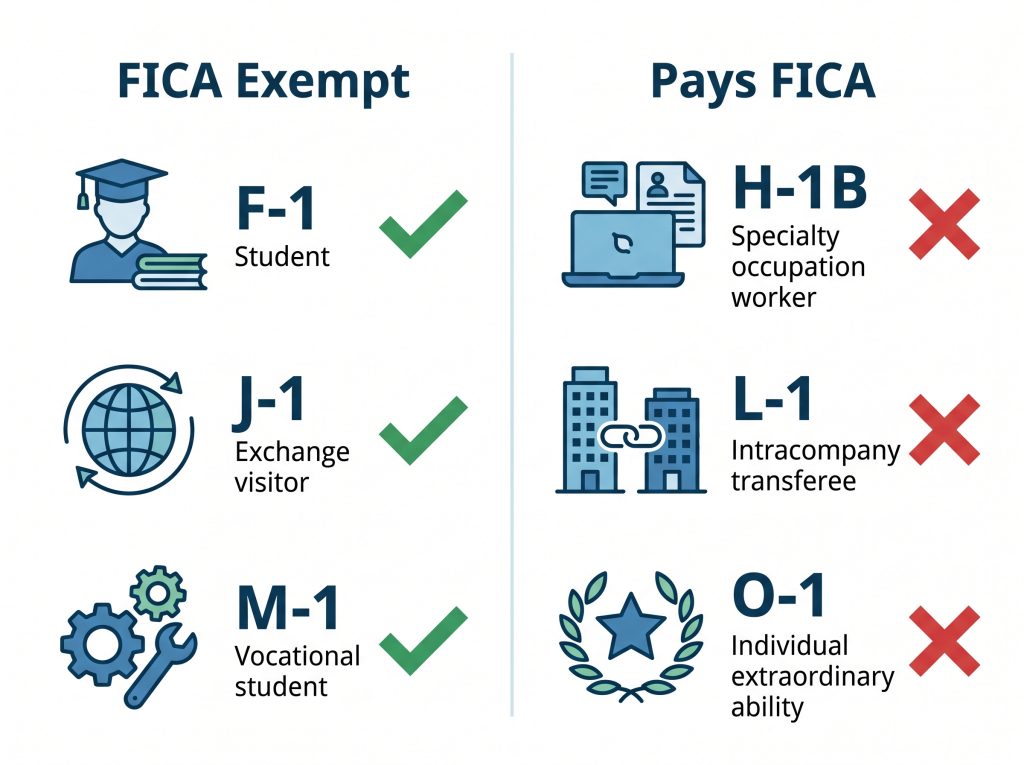
Three things the table does not say but you must know:
First, F-2, J-2, and M-2 dependents are not exempt. If you are the spouse or dependent of an F-1 student, you owe FICA on any wages you earn even if your sponsor pays nothing.
Second, H-2A agricultural workers are also exempt under IRS Publication 519 (page 62), but that is a narrow category most immigrants on this site will not encounter.
Third, the exemptions above only apply while you remain a nonresident alien. The moment you cross into resident alien status through the Substantial Presence Test most of these exemptions disappear, even if your visa has not changed. That is the trap most people fall into, and the next section explains it.
The 5 Calendar Year Rule: The Trap Thousands of Immigrants Fall Into
The F-1 FICA exemption lasts five calendar years. That sounds simple. It is not.
What “calendar year” actually means: A calendar year is January to December. Any presence in the US during a calendar year even a single day counts as a full year. If Alex arrived in the US on August 15, 2020, that entire year is Year 1. By 2025, he has used up all five years, and starting January 1, 2025, he must count his days under the Substantial Presence Test.
The Substantial Presence Test (SPT): To become a resident alien, you must be physically present in the US for at least 31 days during the current year, and when you add up:
- All your days in the current year, plus
- One third of your days from last year, plus
- One sixth of your days from two years ago
…the total must reach 183 days or more.
Most F-1 students who have been in the US continuously since 2020 crossed this threshold sometime in 2025. Their employers may not have noticed. Their FICA exemption may have already expired without anyone telling them. If you are in a year where your status changed, that is a dual-status tax year with its own filing rules.
When you become a resident alien, Section 3121(b)(19) no longer applies. You owe FICA on all wages going forward, even if you are still holding an F-1 visa.
The exception that no other article explains Section 3121(b)(10):
There is a second FICA exemption buried in the tax code that applies to students regardless of their tax residency status. Under IRC Section 3121(b)(10), wages paid by a school, college, or university to a student enrolled at least half time are exempt from FICA even if that student has become a resident alien.
This is the on campus student exception. If a 6th-year PhD student is working as a teaching assistant or research assistant at their own university, enrolled half time or more, their on campus wages remain FICA-exempt even after the 5 year nonresident window closes.
This does not apply to OPT work, off campus work, or any work performed for a private employer. But for students employed directly by their university, it is a real and often missed exemption. Many university HR departments get this wrong and start withholding FICA the moment they see the SPT threshold crossed.
If this applies to you, cite Revenue Procedure 2005-11 and IRC Section 3121(b)(10) to your payroll department.
The F-1 to H-1B Mid Year Transition: What No One Else Explains
Every October, thousands of immigrants switch from F-1 OPT or STEM OPT to H-1B status. Almost none of their employers handle the payroll correctly.
This is the single most undercovered topic in every competing article. It is also where most overpayments happen.
The rule is exact: The FICA exemption ends on the precise effective date of the H-1B status change confirmed by the IRS directly. Wages for services performed before that date remain FICA exempt. Wages for services performed on or after that date are subject to full FICA withholding.
Because most H-1B cap approvals take effect on October 1, the year splits cleanly:
- January 1 through September 30: F-1/OPT wages → FICA exempt
- October 1 through December 31: H-1B wages → full FICA applies
What this means in real dollars:
Alex Rivera earns $100,000 per year, or about $8,333 per month. His STEM OPT ended September 30 and his H-1B began October 1.
| Period | Wages | FICA Due |
|---|---|---|
| Jan 1 – Sep 30 (9 months) | $75,000 | $0 |
| Oct 1 – Dec 31 (3 months) | $25,000 | $1,912.50 |
| Full year | $100,000 | $1,912.50 |
If Alex’s employer withheld FICA on his full $100,000 salary, they took $7,650 from him. He was overcharged by $5,737.50. That money is recoverable.
Why employers get this wrong:
Payroll systems like ADP and Workday do not automatically reconfigure when an employee’s visa status changes. If HR does not manually update the tax code on the effective date of the H-1B approval, the system defaults to treating the employee as FICA taxable for the entire year. This happens constantly.
The employer also needs to split how they report wages on Form 941 (Employer’s Quarterly Federal Tax Return) and on the employee’s W-2. Pre-transition wages should not appear in Box 3 (Social Security wages) or Box 5 (Medicare wages). Post transition wages should. If they lump everything together, the W-2 overstates FICA wages.
What about cap gap?
If you are in cap gap status meaning your H-1B was approved and you are waiting for October 1 between the expiry of your OPT and the start of your H-1B you remain in F-1 status during that gap. FICA exemption continues during cap gap. The moment October 1 hits and your H-1B activates, FICA begins.
What to do if your employer withheld FICA before October 1:
First, request a correction from your employer and a corrected W-2c. If they refuse, move to the full refund process in the next section. The statute of limitations is three years from the date your return was filed do not wait.
How to Get a FICA Refund: The Complete Step by Step Process
This is what tax software companies charge you for. Here it is, free.
Step 1: Contact Your Employer First
The IRS will reject your direct refund claim if you skip this step.
Email or visit your HR and payroll department. State clearly that you are a nonresident alien holding an F-1 (or J-1 or M-1) visa and that your wages are exempt from FICA under Internal Revenue Code Section 3121(b)(19). Ask them to refund the erroneously withheld taxes and issue a corrected W-2c.
Attach the following to your request:
- Copy of your passport visa stamp
- Copy of Form I-20 (F-1) or DS-2019 (J-1)
- Copy of Form I-94 (arrival/departure record)
- Copy of your EAD card if you are on OPT or STEM OPT
Step 2: If the Employer Agrees
They will return the withheld amount directly to you and issue Form W-2c (Corrected Wage and Tax Statement). Check that Box 4 (Social Security tax withheld) and Box 6 (Medicare tax withheld) now show $0 or the correct reduced amount. Keep this document you will need it when filing your tax return.
Step 3: If the Employer Refuses File Form 843 with the IRS
Gather the following forms and documents:
Forms to complete:
Form 843 Claim for Refund and Request for Abatement
- Line 4a: Check the box for “Employment” taxes
- Line 4b: Write “Social Security and Medicare Tax (FICA) withheld in error”
- Line 7: Write a brief explanation stating your nonimmigrant visa status, that your wages are exempt under IRC Section 3121(b)(19), and that your employer refused to provide a refund
Form 8316 information Regarding Requests for Refund of Social Security Tax Erroneously Withheld This form certifies that you asked your employer for a refund and were denied, and that you are not authorizing your employer to file the claim on your behalf. Complete it and attach it to your Form 843.
Supporting documents to attach:
- Copy of your original W-2 showing the withheld FICA amounts
- Copy of your passport visa page
- Copy of Form I-94
- Copy of Form I-20 (F-1) or DS-2019 (J-1)
- Copy of your EAD card if applicable
- Copy of your Form 1040-NR for that tax year
- Written denial letter from your employer or if they refused to provide one, a written statement from you explaining your unsuccessful attempts to obtain it
Mailing address: File your completed package with the IRS Service Center that handles your employer’s Form 941 filings. For most nonresident alien FICA refund claims, this is the IRS Service Center in Ogden, UT 84201-0038. File a separate Form 843 package for each tax year and for each employer.
Deadlines Do Not Miss These
You must file within three years from the date the tax return was filed, or two years from the date the tax was paid whichever is later. The IRS treats FICA as filed on April 15 of the following year.
| FICA Withheld In | Refund Claim Deadline |
|---|---|
| 2022 | April 15, 2026 |
| 2023 | April 15, 2027 |
| 2024 | April 15, 2028 |
| 2025 | April 15, 2029 |
Once this window closes, the claim is legally time barred. The IRS will not make exceptions.
Processing time: Expect 6 to 12 months. FICA refund claims are manual paper reviews they are not processed by the same systems as regular income tax refunds. If you are waiting for an international check, be aware that Treasury checks can be difficult to cash abroad. Follow up after six months.
One important exception: Do not use Form 843 for the Additional Medicare Tax (the extra 0.9%). That is claimed as a credit on your Form 1040NR using Form 8959, or via an amended return on Form 1040X for prior years.
What about Social Security benefits from the erroneously paid FICA?
Nothing. Erroneous FICA payments do not count toward your Social Security work credits. To qualify for US Social Security benefits you need 40 credits, earned through legally covered employment. Because F-1 employment is exempt under §3121(b)(19), any FICA withheld from it was an administrative error not a valid contribution. The government treats it that way. You cannot claim future benefits from those payments. Get the refund.
Self Employment Tax for Immigrants: What H-1B LLC Owners Must Know
This section is for immigrants who own businesses, receive 1099 income, or are thinking about starting a side company. Almost no FICA article covers this and it is the most expensive mistake you can make.
FICA and self employment tax are not the same thing. FICA is withheld from W-2 wages by your employer. Self employment tax (SECA) is what self-employed individuals pay instead and the rates are higher because you pay both the employee and employer halves yourself.
The self employment tax rate is 15.3%: 12.4% for Social Security and 2.9% for Medicare.
The rule for immigrants:
| Tax Residency Status | Self-Employment Tax? |
|---|---|
| Nonresident alien (F-1, J-1 in first 5 years) | Not subject to SE tax |
| Resident alien (H-1B, long term F-1, green card) | Fully subject to SE tax at 15.3% |
This seems clean. It is not because most H-1B holders are resident aliens.
The H-1B LLC scenario:
Many H-1B holders own LLCs for e-commerce, consulting, content creation, or investment income. A single member LLC is treated as a disregarded entity by default, which means the profits flow to your Schedule C and are subject to self employment tax.
On $50,000 of LLC net profit, a resident alien H-1B holder owes $7,650 in self employment tax on top of ordinary income tax.
There is no exemption for this. The only mechanism that could reduce SE tax is a totalization agreement, and most H-1B holders from India, China, and Nepal do not benefit from one.
The immigration warning you must hear:
Paying self employment tax does not legalize unauthorized work on an H-1B visa. These are two completely separate systems. The IRS and USCIS do not communicate about this. You can be fully tax compliant on your 1099 income and simultaneously be in violation of your H-1B status. If the work is unauthorized, the immigration consequence applies regardless of how carefully you filed your taxes.
Before operating an LLC on H-1B, read the rules on authorized self employment and speak to an immigration attorney. The tax question and the immigration question must both be answered separately.
Totalization Agreements: What Happens to Your Social Security When You Leave the US
Alex Rivera is Indian. He has been on H-1B for six years. He pays $7,650 per year into US Social Security. If he returns to India permanently after year eight, he will have contributed over $60,000 to the US Social Security system.
He will likely see none of it returned as retirement benefits.
This is the totalization problem and it affects millions of immigrants.
What totalization agreements do:
The US has Social Security totalization agreements with approximately 30 countries. These agreements do three things:
- Prevent double Social Security taxation so a German worker temporarily transferred to the US does not pay into both the US and German systems simultaneously
- Allow “detached workers” on temporary assignments to remain in their home country’s pension system via a Certificate of Coverage
- Allow workers to combine US and home country work credits toward the 40 credit threshold required for US Social Security benefits
Countries with US totalization agreements include: Canada, UK, Germany, France, Japan, South Korea, Australia, Italy, Spain, Switzerland, Netherlands, Sweden, Norway, Brazil, Chile, Poland, Portugal, Ireland, and Belgium.
Countries without US totalization agreements include: India, China, and Nepal.
These three countries represent a massive share of the H-1B and L-1 workforce. And their workers have no protection.
What this means in practice:
To collect US Social Security retirement benefits, you need 40 credits roughly 10 years of covered work. If you leave the US before hitting 40 credits and your home country has a totalization agreement with the US, you may be able to combine your US and home country work credits to qualify for partial benefits from each.
If you are from India and leave after 8 years with 32 credits, those credits cannot be combined with Indian pension credits. You fall short of 40. You receive nothing from US Social Security. There is no refund mechanism for FICA paid on legal H-1B employment.
A Japanese engineer in the same situation gets partial benefits from both countries. An Indian engineer in the same situation gets nothing from the US system.
This is not an obscure planning issue. It is a real financial consequence that most H-1B workers from India have never been told about.
The Certificate of Coverage:
If you are an L-1 worker transferred from a country that has a totalization agreement say, Germany your German company can obtain a Certificate of Coverage from the German social security agency proving you remain covered under the German system. You present this to your US employer. Your employer stops withholding US FICA. You pay only into the German system during your assignment.
Without the certificate, your employer must withhold US FICA regardless of what your home country is doing. The certificate is the mechanism. Without it, there is no exemption.
The temporary assignment window: Most totalization agreements allow detached worker status for assignments up to five years. Beyond that, the US expects you to enter the US Social Security system fully.
Common FICA Mistakes Immigrants Make
1. Assuming the F-1 exemption lasts as long as you hold an F-1 visa. It does not. It lasts until you become a resident alien under the Substantial Presence Test which can happen while you are still on F-1 status. Year 6 is the danger zone.
2. Miscounting calendar years. Arrived in November 2020? That is Year 1. You have been in the US for less than two months but consumed a full calendar year. Most people count incorrectly by months rather than calendar years.
3. Letting employers withhold FICA for the full year after an October 1 H-1B change. This is the most expensive payroll mistake in immigration tax. Wages before October 1 are F-1 wages. They are exempt. The split is mandatory. If your W-2 shows FICA withheld on pre October wages, that is recoverable.
4. Missing the 3 year refund deadline. FICA withheld in 2022 has a recovery deadline of April 15, 2026. If you are reading this now and realized you overpaid in 2022, move immediately.
5. Using TurboTax or H&R Block for a nonresident alien return. These software products do not support Form 1040NR. They will file you as a resident when you are not. Use Sprintax or Glacier Tax Prep for nonresident returns, or work with a CPA who handles international tax.
6. Assuming LLC profits are not subject to self employment tax. As a resident alien H-1B holder, your LLC net profits flow to Schedule C and are subject to the full 15.3% SE tax. There is no exemption.
7. Expecting a refund of FICA contributions when you leave the US permanently. Social Security is not a savings account. You cannot withdraw contributions. If you leave before 40 credits and your country has no totalization agreement, those years of contributions may produce no benefit. Plan for this.
8. Confusing income tax treaties with totalization agreements. These are completely separate instruments. A tax treaty between the US and your home country may reduce income tax. It does nothing for FICA or Social Security. Only a totalization agreement addresses Social Security and most countries do not have one with the US.
Frequently Asked Questions
Do F-1 students pay Social Security tax?
No, as long as you are a nonresident alien within your first 5 calendar years in the US, your wages from authorized employment are exempt from Social Security and Medicare taxes under IRC Section 3121(b)(19).
Do OPT and STEM OPT students pay FICA?
No, OPT and STEM OPT employment is specifically included in the F-1 FICA exemption, provided you remain a nonresident alien. Your EAD card documentation confirms this with the IRS.
When does FICA start after switching from F-1 to H-1B?
On the exact effective date of your H-1B approval usually October 1 for cap subject cases. Not before, not retroactively. Wages paid for services after that date are subject to FICA; wages before that date are not.
Can I still get a FICA refund after my status changed to H-1B?
Yes, if FICA was withheld during the period you were still on F-1 status. File Form 843 and Form 8316 with supporting documentation. The 3 year statute of limitations applies.
Does an H-1B visa holder pay FICA?
Yes, fully, from day one. H-1B workers are treated exactly like US citizens for FICA purposes. There is no status based exemption.
Do J-1 visa holders pay Medicare tax?
J-1 students are exempt from FICA (including Medicare) for 5 calendar years. J-1 scholars, teachers, and researchers are exempt for 2 calendar years. After the applicable period, once they become resident aliens, Medicare tax applies.
What happens to my Social Security contributions if I leave the US permanently?
It depends on whether your home country has a totalization agreement with the US and whether you have reached 40 work credits. If you have 40 credits, you may be eligible for US Social Security benefits even after leaving. If you fall short and your country has a totalization agreement, combined credits may help you qualify. If your country has no agreement India, China, Nepal contributions made on legal employment cannot be recovered and may produce no benefit.
Does an LLC owner on H-1B pay self employment tax? Yes. As a resident alien, LLC net profits on Schedule C are subject to the full 15.3% self employment tax. There is no FICA exemption for H-1B holders, and SE tax is the self employed equivalent of FICA.
Can I collect Social Security benefits after leaving the US?
Potentially yes, if you earned 40 credits or qualify through a totalization agreement. The SSA pays benefits to people living outside the US in most countries. Check the SSA’s international programs page for country specific rules.
What countries have totalization agreements with the US?
Approximately 30 countries, including Canada, UK, Germany, France, Japan, South Korea, Australia, Italy, Spain, and Switzerland. India, China, and Nepal currently do not have agreements with the US. The full list is on the SSA’s international programs page at ssa.gov/international.
Summary: FICA Rules for Immigrants at a Glance
- F-1, J-1, M-1, and Q-1 nonresident aliens are exempt from FICA under IRC Section 3121(b)(19) for 5 years if students, 2 years if J-1 non students
- H-1B, L-1, O-1, TN, E-3, and H-4 EAD holders owe full FICA from day one
- The exemption ends on the exact date of a status change to a non-exempt visa
- If you switched from F-1 to H-1B on October 1, your pre October wages are still FICA exempt
- FICA wrongly withheld can be recovered via Form 843 and Form 8316 within 3 years
- Resident aliens pay self employment tax at 15.3% on business and 1099 income
- Totalization agreements prevent double Social Security taxation but India, China, and Nepal are not covered
- Immigrants from non agreement countries who leave before 40 work credits may lose all Social Security contributions
If you found FICA taxes were withheld incorrectly from your paycheck, start with your employer. If they refuse, use the Form 843 process described above. Do not wait the statute of limitations is real, and the money is yours to recover.
The information on this page is for educational purposes only and reflects rules as of 2026. FICA and Social Security rules can change. For advice specific to your situation, consult a qualified US tax professional or immigration attorney familiar with nonresident alien tax law.